



Summary:
Higher rates have challenged long-maturity assets, but they have improved the economics of insurance. Premiums and collateral can earn more, supporting more competitive annuity terms and stronger starting economics for disciplined insurance strategies.
Want a broader view of this quarter’s trends? Download the full market outlook for insights across equity, fixed income, and private markets.
Our Perspective
The same rate backdrop that challenges long-maturity assets can improve the economics of insurance. Select annuities may strengthen a financial plan, while insurance-linked and underwriting-led strategies can offer differentiated return sources. Each serves a different role, but together they may broaden the opportunity set and reduce reliance on the narrow outcomes driving public markets.
The Other Side of Higher Rates
Most market discussions focus on what higher rates make harder; borrowing costs rise, bond prices fall, and the equities of companies that have a longer runway toward profitability reprice, often lower. Insurance sees the same environment from the other side of the balance sheet.
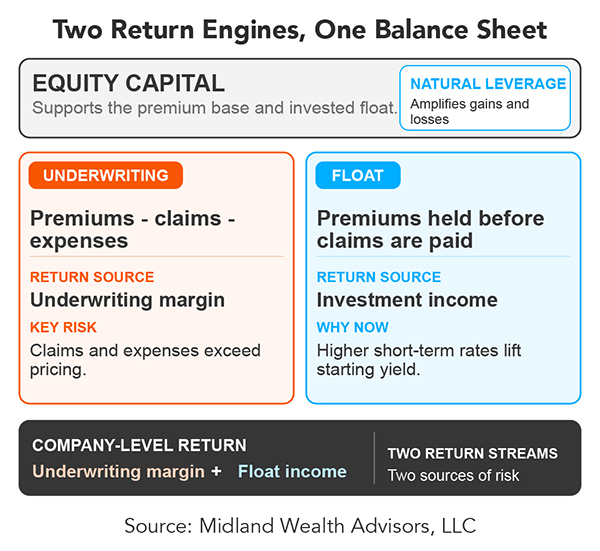
Policyholders pay premiums before claims are settled. The premiums held and invested during that period are referred to as insurance float. A reinsurer (a firm that provides insurance coverage to an insurance company) can earn profits from underwriting (when premiums exceed claims and expenses) and from investing this float. The combined ratio measures the first cashflow stream. When the combined ratio is less than 100%, the underwriting process is profitable; when it is greater than 100%, the opposite is true.
The benefit of a higher rate environment also reaches annuity policyholders. A multi-year guaranteed annuity (MYGA) locks in a stated rate for a set term, while a fixed index annuity (FIA) provides market-linked interest credits. FIA terms may include a cap (the maximum return credited) or a participation rate (the share of an index’s gains credited to the contract). A 75% participation rate, for example, would credit 7.5% if the index rose 10%, before other provisions. Higher yields can support stronger caps and participation rates. Higher long-term yields can also support more attractive lifetime income payments because insurers match long-dated payment obligations with longer-maturity bonds, a form of liability-driven management. Paired with the right plan and liquid investment portfolio, an annuity can transfer some reinvestment or market risk to an insurer and reduce the return burden on remaining assets. Guarantees depend on the carrier’s claims-paying ability and the contract’s liquidity and surrender terms.
Higher rates do not automatically rescue poor underwriting or make every contract attractive. They do, however, make disciplined insurance more valuable because the investment portfolio does not need to reach as far for return.
Why a Few Points Matter
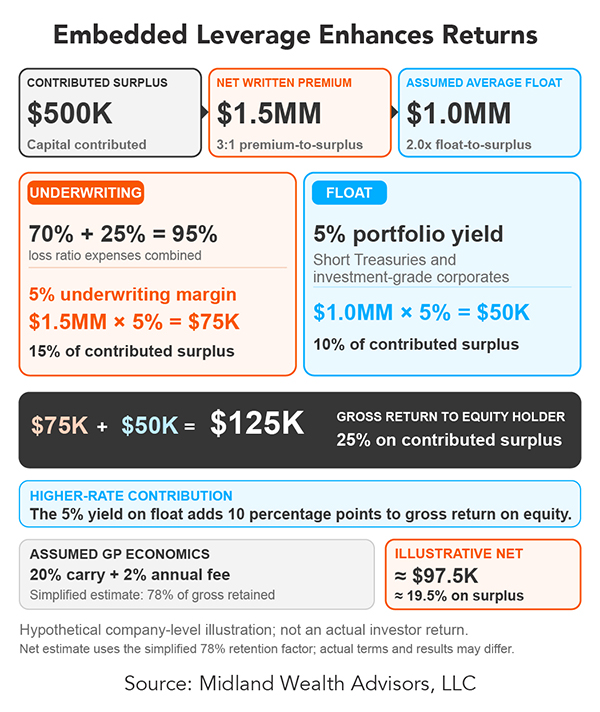
Regulatory capital requirements can support multiple dollars of premium, and a meaningful portion may remain invested before claims are paid. This is the natural leverage built into the insurance business model. No borrowing is required, but the pool of capital earning income can be larger than the equity stake supporting it.
A modest change in float yield can therefore have an outsized effect on company-level returns. The reverse is also true; a weaker combined ratio can quickly absorb the benefit of higher investment income.
Many reinsurance contracts renew annually, allowing underwriters to adjust price and terms as claims data changes. The opportunity depends on finding books with a reasonable margin for error and keeping the assets backing claims conservative and liquid
Same Theme, Different Roles
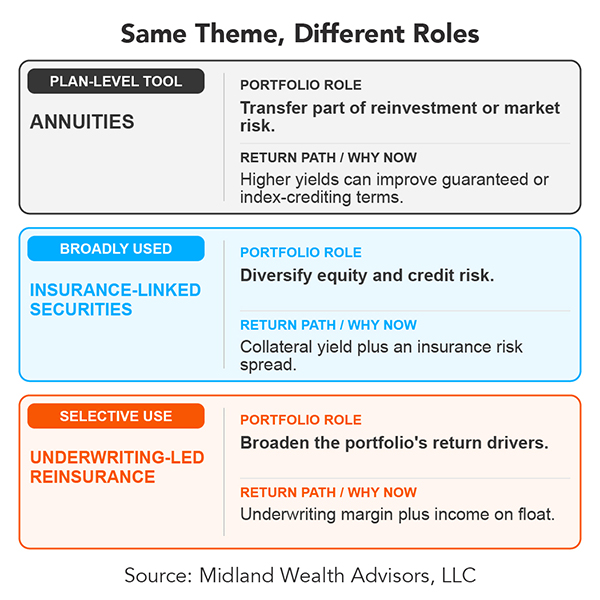
We have written about and extolled the benefits of select insurance-linked strategies, including the use of catastrophe bonds (cat bonds) as diversifiers. The current strategy the team uses in the core lineup primarily invests in cat bonds, which pay income in exchange for the risk of principal loss if a defined catastrophe occurs.
Because returns are more closely tied to insured events than to corporate earnings or to credit spreads more broadly, cat bonds can provide a return stream distinct from that of traditional public markets. Their floating coupons and short-term collateral also benefit from higher rates.
That existing exposure is one expression of a broader opportunity set. Underwriting-led reinsurance can focus on many smaller claims across casualty, health, or specialty lines. Returns come from underwriting and float; the key questions are whether premiums, reserves, and claims development are sound.
Annuities serve a different purpose. They sit on a client’s personal balance sheet as planning tools; insurance-linked securities and reinsurance are portfolio investments. None replaces another. Each option pools or transfers risk, but with different objectives and liquidity constraints.
A Different Return Engine
Public markets remain the foundation of most client portfolios. But as the equity section notes, index returns increasingly depend on a small group of companies. That makes the source of diversification more important.
Insurance is not a hedge against every market decline or broad market volatility. Still, claims experience does not move in lockstep with equity multiples or credit spreads. Insurance-linked securities add event risk, reinsurance adds underwriting and reserve risk, and annuities can shift a portion of market or reinvestment risk away from the liquidity sleeve (often fixed income) of client portfolios.
Higher rates make collateral and float more productive, improve contract economics, and increase the value of returns tied to a different process.
Portfolio Implications
Higher rates have widened the range of insurance-based tools worth considering. Over time, there may be room to complement core public markets exposures with different claims profiles and return engines.
At the individual level, select annuities may improve the fit between a plan and investment portfolio. Locking in a rate or exchanging some upside for contractual protection can reduce the market risk required to meet a goal, provided the contract’s liquidity terms and carrier strength are appropriate.
Insurance is not immune to loss. The point is that higher rates have improved the terms on both sides of the balance sheet. In a portfolio dependent on narrow public market outcomes, using insurance to transfer some risks and earn compensation for bearing others has become more valuable.
Insurance strategies can provide different ways to manage risk, generate income, and diversify a portfolio. Interested in learning more? Connect with a Midland Wealth Advisor.
Past performance is no guarantee of future results. Investing involves risk, including possible loss of principal. Alternative and private-market investments may involve additional risks, including illiquidity, limited transparency, valuation uncertainty, leverage, concentration, manager risk and loss of principal. The use of leverage can magnify both gains and losses.
Diversification and asset allocation do not ensure a profit or protect against loss.


