



Summary:
Treasury yields have risen sharply across the curve, pressuring equities, credit, and financing conditions while reshaping investor expectations around inflation, growth, AI investment, fiscal risk, and global markets today.
Want a broader view of this quarter's trends? Download the full market outlook for insights across the equity, fixed income, and private markets.
Our Perspective
Higher rates pose an increasingly important headwind for companies seeking to raise or refinance debt, particularly financially strained issuers facing materially higher borrowing costs and tighter credit conditions ahead.
The Yield Curve: A Three-Part Story
The Treasury curve has evolved meaningfully over the past year. What began as a story about when the Fed would cut rates has become a broader repricing of inflation, growth, capital demand, and fiscal risk. Over the last quarter, yields moved 0.90% to 1.36% (90 to 136 basis points), with different forces driving different maturities.
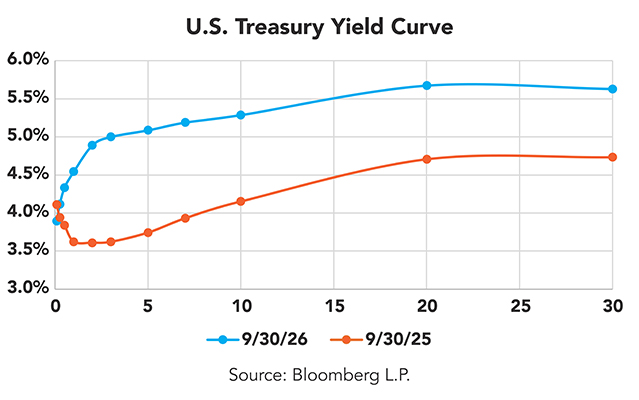
At the front end of the curve, yields remain tied to inflation and the Fed’s reaction function. The 2-year Treasury yield fell to a low of 3.38% in February as the Fed cut rates three times, before reversing course and surging to 4.90% by quarter-end as policymakers raised rates to combat renewed inflation pressures.
The challenge is that today’s shock is largely supply-driven. Higher rates can slow demand, but they cannot create more oil. If the Strait of Hormuz remains effectively closed, elevated energy prices can continue filtering through the economy, keeping the Fed restrictive and the front end elevated.
The belly of the curve—roughly 3- to 7-year maturities—reflects expectations for growth, capital investment, and where policy rates may settle. Today, the dominant investment story is the AI infrastructure buildout.
Hyperscalers are increasingly financing that spending through 5- to 10-year debt. As more corporate issuance competes for investor capital, yields must adjust, including Treasury yields competing for those same dollars.
AI could also influence the economy’s longer-run growth rate. If it delivers on part of its productivity promise, businesses may produce more with the same labor and capital. A more productive economy can sustain stronger growth without overheating, potentially supporting a higher neutral, or “normal,” rate of interest. Markets may therefore be repricing not just the current cycle, but where rates ultimately settle.
At the long end, the focus shifts to fiscal risk. Growing Treasury supply, deficits, debt service, and future borrowing needs are pushing investors to demand a higher term premium for lending to the government over longer periods.
Real yields, or those adjusted for the effects of inflation, have also moved higher, creating opportunity. Treasury Inflation Protected Securities (“TIPS”) have become increasingly attractive, with investors able to lock in a 3.3%+ real yield on a 30-year Treasury while retaining inflation protection if the Middle East conflict prolongs the oil shock.
The rise in real yields has improved the relative attractiveness of TIPS within our fixed income portfolios. In response, we allocated to the asset class, seeking stronger inflation-adjusted yields with protection should inflation prove more persistent.
The AI Debt Machine
AI-related capital expenditures among Hyperscalers have grown from about $400 billion in 2025 to estimates approaching $1 trillion by 2027. What was once funded primarily through internal cash flow is increasingly moving into debt markets.
In 2025, investment-grade (“IG”) debt issuance totaled about $1.6 trillion, with Amazon, Google, Nvidia, Oracle, and Meta accounting for approximately $79 billion. This year, overall IG issuance is roughly flat, yet those three companies alone have issued more than $250 billion, nearly 150% increase.
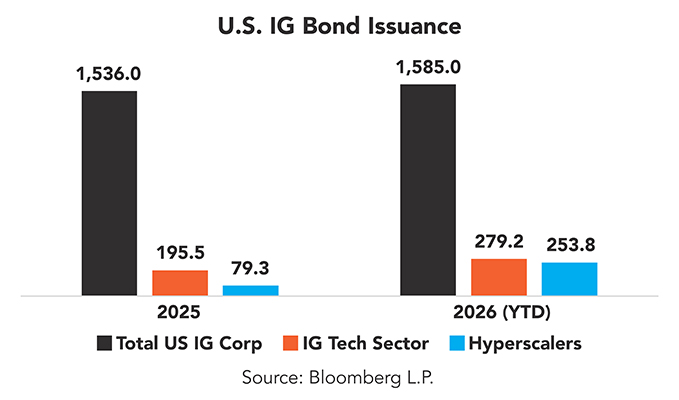
Markets are beginning to question how sustainable that pace may be. Nearly 42% of investors identify AI Hyperscaler spending as the most likely source of a systemic credit event. That concern is appearing in pricing, with traditional IG credit offering roughly 0.80% over Treasuries versus approximately 1.37% for Hyperscaler debt.
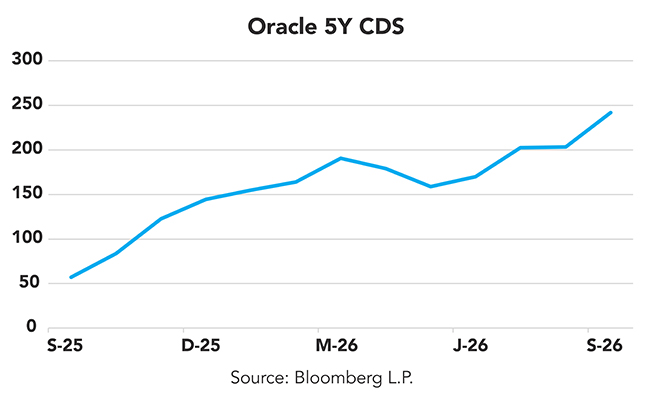
Credit default swaps (“CDS”) tell a similar story. Think of a CDS as insurance on company debt: the higher the cost, the greater the perceived credit risk. Oracle provides a useful example, with the cost of insuring its debt rising alongside its AI commitments.
That does not mean Oracle is approaching default. Investors are instead questioning whether today’s leverage and spending will be supported by future AI-related cash flows. For now, Hyperscalers can support significant investment, but persistently high financing costs may eventually constrain the pace of the AI buildout.
Cracks in the Credit Facade
Stress is also emerging at the opposite end of the credit spectrum. CCC-rated spreads recently approached 1,000 basis points over Treasuries, while investment-grade, BB-, and B-rated spreads remain relatively contained. Investors are not broadly abandoning corporate credit; they are becoming more selective about lending to the weakest borrowers.
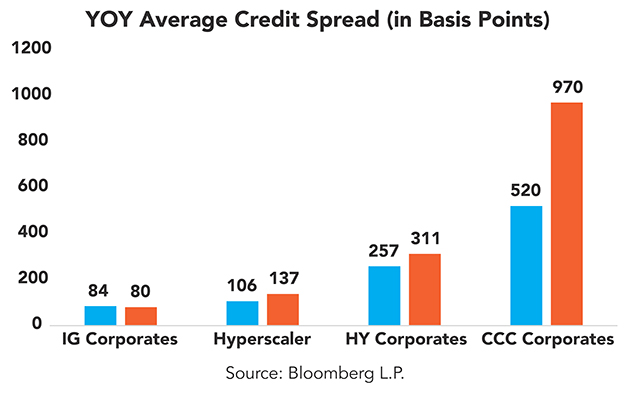
The larger concern is the refinancing wall. Many lower-quality companies built their capital structures when benchmark rates were near zero. As that debt matures, borrowers must refinance while Treasury yields and credit spreads are materially higher.
For CCC-rated bonds maturing in 2027 and 2028, PIMCO estimates coupons could potentially double if refinanced at current yields. For highly leveraged companies with limited free cash flow, that increase in interest expense can quickly turn a manageable debt load into a balance-sheet problem.
For now, stress remains concentrated at the weakest end of the market. The key signal will be whether it begins migrating into B-, BB-, or eventually investment-grade credit. If it does, higher rates would move beyond isolated weak borrowers and begin to weigh more broadly on corporate profitability.
As rates and credit conditions evolve, understanding where risks and opportunities are emerging can help inform portfolio decisions. Connect with a Midland Wealth Advisor.
Past performance is no guarantee of future results. Investing involves risk, including possible loss of principal. Fixed-income investments are subject to interest-rate, credit, liquidity and market risk. Bond values generally decline as interest rates rise.
Market indices are unmanaged and are presented for informational and comparative purposes only. Index returns do not represent the performance of an actual investment account and generally do not reflect investment management fees, transaction costs or other expenses. It is not possible to invest directly in an index.


