



Summary:
Geopolitical conflict and supply chain reorganization are reinforcing a less integrated global economy. The result is not the end of globalization, but a more fragmented version of it, one where country-level fundamentals, resource security, policy alignment, and supply chain resilience should play a larger role in determining risk premia, or the additional compensation investors demand for accepting uncertainty, volatility, or potential loss beyond what they could earn from a safer asset.
Want a broader view of this quarter's trends? Download the full market outlook for insights across the economy, fixed income, and private markets.
Our Perspective:
The world is moving from frictionless integration toward selective interdependence. Trade remains global, but governments and corporations are increasingly reassessing where critical production occurs, who controls essential inputs, and how much geopolitical risk is embedded in cross-border exposure. For investors, this argues for greater selectivity across regions, countries, sectors, currencies, and asset classes.
REORGANIZATION: A RETHINKING OF GLOBAL SUPPLY CHAINS
The immediate geopolitical focus remains the Strait of Hormuz, but the waterway is best understood as one part of a broader shift taking place across the global economy. The Iran War has disrupted energy logistics and trade routes while reminding investors that supply chains, transportation corridors, and funding markets remain vulnerable to geopolitical stress.
At the same time, the U.S. economy is less exposed to traditional oil shocks than it was in prior decades. Domestic energy production has improved materially, and oil-related spending now represents a smaller share of overall economic activity than during prior periods of energy stress. That does not mean energy no longer matters. It does. Higher energy prices can still affect inflation expectations, consumer sentiment, corporate margins, and monetary policy. But the transmission mechanism is different. The market impact may show up less through an immediate growth shock and more through inflation sensitivity, term premia, and country-level dispersion.
Put simply, the conflict highlights a world that is becoming less integrated and more fragmented.
Countries are reassessing their interdependence and increasingly organizing around political, economic, and strategic alliances. The processes of on-shoring, near-shoring, and friend-shoring have moved from corporate talking points to policy priorities. In the U.S., this shift has already produced a meaningful change in trade patterns. Previously dominated by China, U.S. imports have increasingly shifted toward Mexico, with the southern neighbor becoming America’s largest trading partner earlier this year.
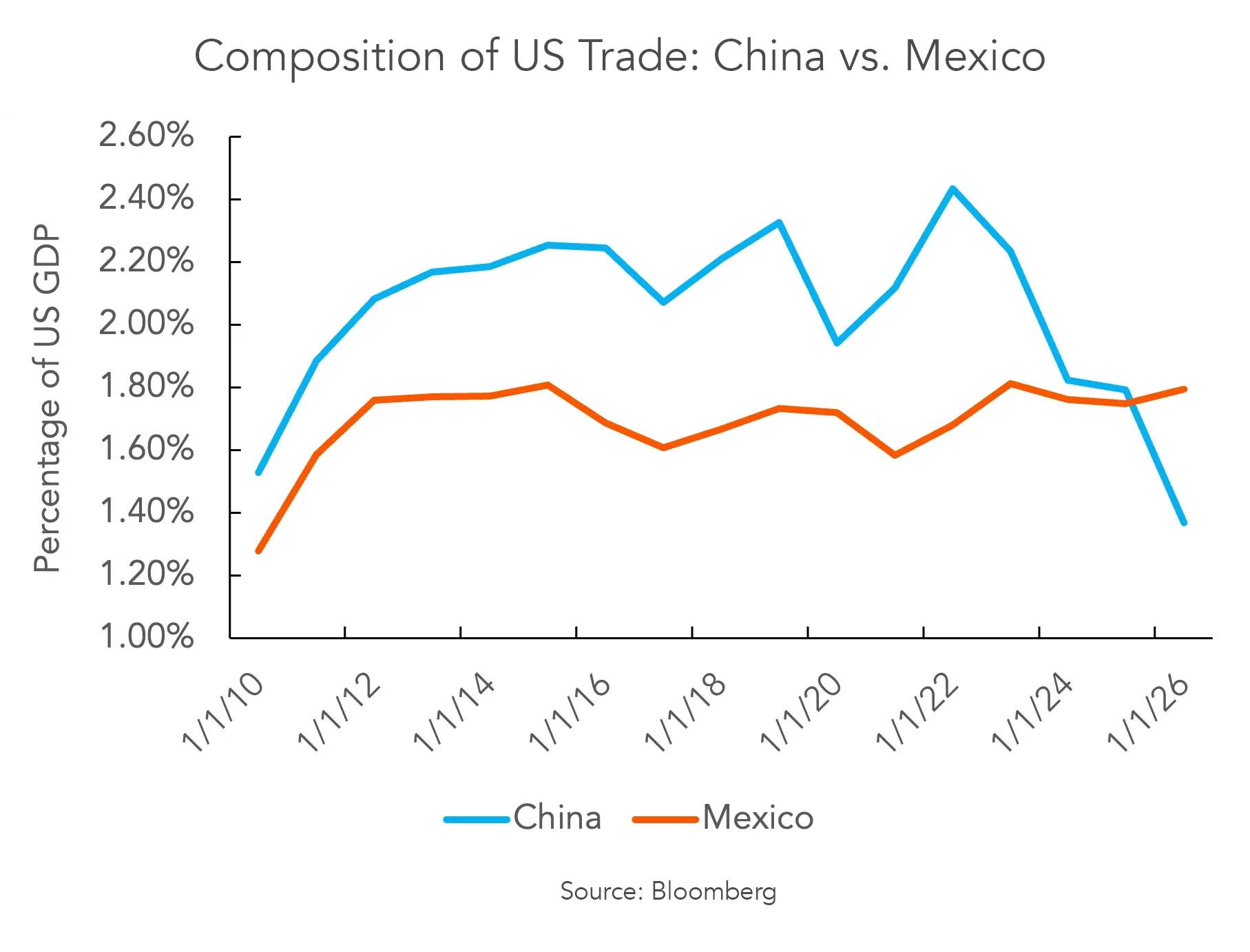
This is not solely a U.S. phenomenon. At the most recent G7 conference, the conversation also centered on reorganizing European trade away from China. The rationale is straightforward: as competition for critical minerals intensifies, China’s control over key inputs has given the country significant pricing power and supply-chain influence. These concerns will continue to reshape trade relationships, capital flows, and the way countries think about economic security.
Technology may be the clearest example of how far this reordering has moved beyond traditional goods trade. The artificial intelligence infrastructure buildout depends on semiconductors, high-bandwidth memory, advanced networking equipment, data-center capacity, power availability, and critical minerals. These inputs are global, but not evenly distributed. As a result, the beneficiaries of this cycle are not confined to the United States, nor are the risks.
Supply chains have become a key macroeconomic and geopolitical consideration. Countries with access to critical resources, reliable trade partnerships, credible policy frameworks, and strategic relevance to AI and energy infrastructure may command lower risk premia over time. Countries more exposed to chokepoints, import dependency, fiscal instability, or policy uncertainty may require greater compensation from investors.
Fragmentation can redirect opportunity toward countries and sectors positioned to benefit from new trade routes, resource needs, and capital spending priorities. Select emerging markets, commodity exporters, and semiconductor-linked economies may benefit as production, capital spending, and trade relationships diversify. But the broader investment implication is that country-level dispersion should rise.
In a more fragmented world, it will matter less whether an investor owns “international” exposure in broad terms and more which countries, currencies, sectors, and supply chains they own specifically.
SELECTIVE INTERDEPENDENCE: THE NEW GLOBALIZATION
The next phase of globalization is unlikely to resemble the last one. The prior cycle was defined by low friction, expanding trade, and globally synchronized supply chains. The coming cycle appears more likely to favor redundancy, resilience, and regional alignment.
This implies that global trade will become more strategic. Governments will likely continue to protect industries that are sensitive to national security, secure access to critical resources, and prioritize supply-chain reliability over lowest-cost production. Corporations, in turn, will likely place greater value on certainty, proximity, and political alignment when making long-term capital decisions.
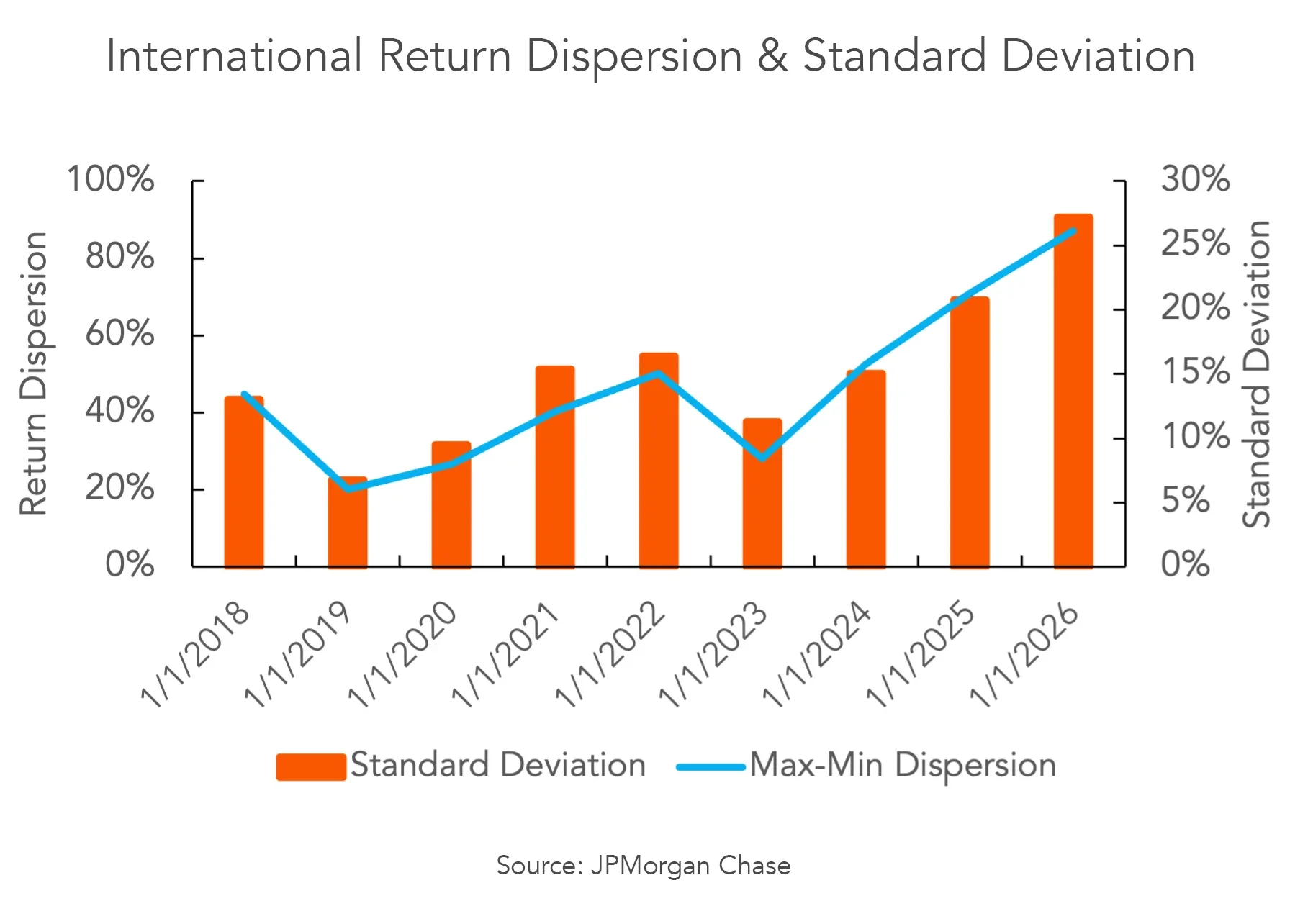
For investors, this means risk premia should become more differentiated. Policy credibility, fiscal position, energy security, resource access, labor availability, currency stability, and geopolitical alignment are likely to matter more than they did in the prior era. That does not mean global diversification is less important. In fact, the opposite may be true. But diversification must become more intentional.
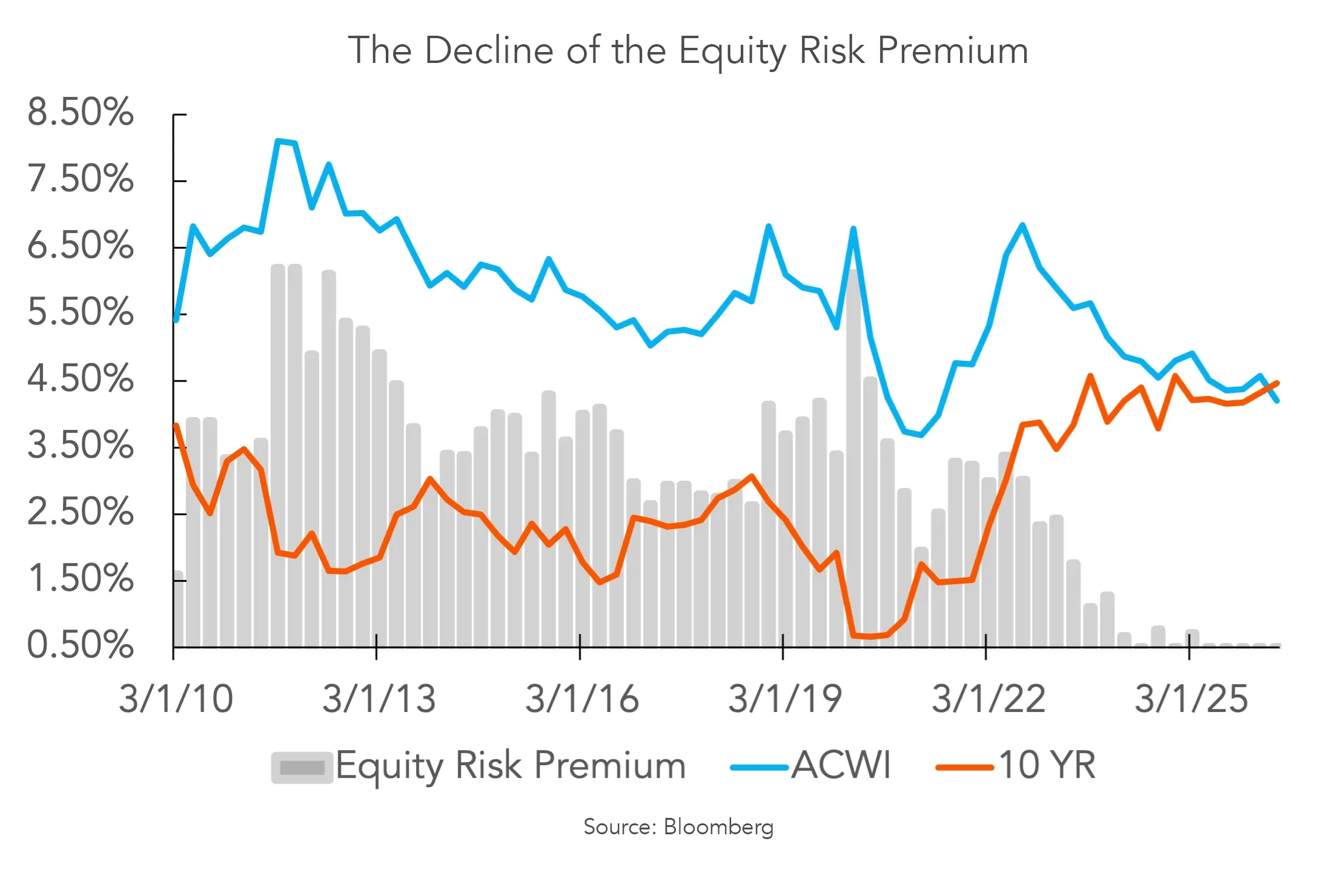
The same fragmentation that is changing trade flows is also changing the way investors price capital. Less reliable supply chains, greater energy uncertainty, larger fiscal deficits, and more capital-intensive technology investment all argue for a higher hurdle rate. In fixed income, that shows up through term premium, credit selection, and the need to be more conscious of duration and liquidity risk. In equities, it shows up through concentration risk, valuation discipline, and the need to distinguish between companies benefiting from the AI buildout and those merely attached to the narrative.
This is where selectivity becomes the common thread across asset classes. The AI infrastructure buildout may continue to support earnings growth and capital spending, but the winners are unlikely to be evenly distributed. Similarly, higher long-term yields may improve the return profile for fixed income investors, but only where compensation is adequate for the risks being taken.
CONCLUDING THOUGHTS
Taken together, fragmentation and compressed risk premia suggest the next phase of the cycle should reward discernment over indexing. Global exposure certainly has a role, but the benefit is likely to come less from owning everything and more from understanding where supply chains, policy choices, currencies, and capital costs are creating durable advantages, or exposing investors to underappreciated fragility.
In a world where risk premia are compressed and outcomes are becoming more differentiated, prudence is not about avoiding risk altogether. It is about being more deliberate about where risk is taken.
As the global economy evolves, understanding where opportunities and risks are changing can make a difference. Connect with a Midland Wealth Advisor.


