


Summary:
Despite macro and geopolitical headwinds, markets advance as AI infrastructure broadens beyond mega-cap tech.
Want a broader view of this quarter’s trends? Download the full market outlook for insights across the economy, fixed income, and private markets.
Our Perspective:
We remain constructive on AI’s long-term opportunity, but after a historic run, execution matters more. Selectivity, valuation discipline, and concentration management are increasingly important.
MARKETS LOOK PAST THE NOISE
Despite a complicated economic and geopolitical backdrop, U.S. equity markets have continued to post double-digit returns in 2026. Sticky inflation, elevated rates, bond-market volatility, and renewed geopolitical conflict all have the potential to weigh on investor sentiment. Yet the S&P 500 is up about 10.2% year to date, while the Nasdaq 100 and Russell 2000 have delivered stronger gains. Rather than being derailed by macro uncertainty, markets have remained focused on one dominant theme: the buildout of artificial intelligence infrastructure.
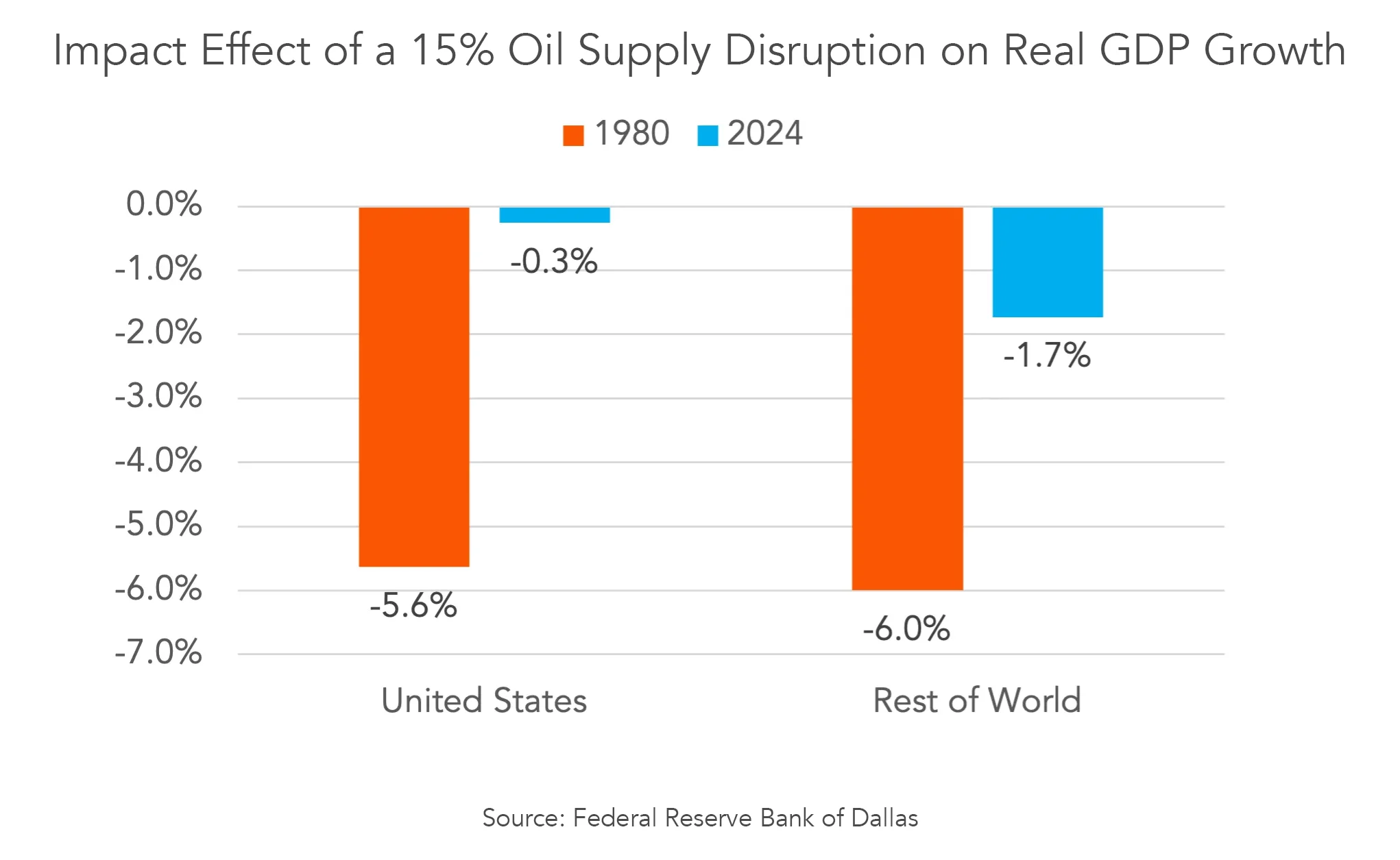
One reason investors have been able to look past geopolitical stress is that oil shocks no longer transmit through the U.S. economy with the same force as in prior decades. In the 1970s and 1980s, the U.S. was far more dependent on foreign oil imports, making supply disruptions a direct threat to growth, inflation, and consumer spending. Today, the U.S. is in a much stronger energy position, producing significantly more of its own oil and exporting more energy than in past cycles. At the same time, oil and petroleum-related spending represents a smaller share of GDP than it did during prior energy shocks. Oil still matters, particularly for inflation expectations and market sentiment. Still, the U.S. economy is less exposed to a sustained growth shock than it was during earlier periods of geopolitical conflict.
AI REMAINS THE MARKET ENGINE
That structural resilience has allowed investors to focus on the more powerful market story: the AI infrastructure and semiconductor supercycle. The Philadelphia Semiconductor Index has been the clearest expression of this theme, rising roughly 80% year to date, compared with an approximately 10% gain for the S&P 500. The rally has been fueled by extraordinary demand for AI compute, high-bandwidth memory, advanced networking, semiconductor equipment, power infrastructure, and data-center capacity. In many ways, the market has shifted from rewarding the companies that first popularized AI to those that physically build it.
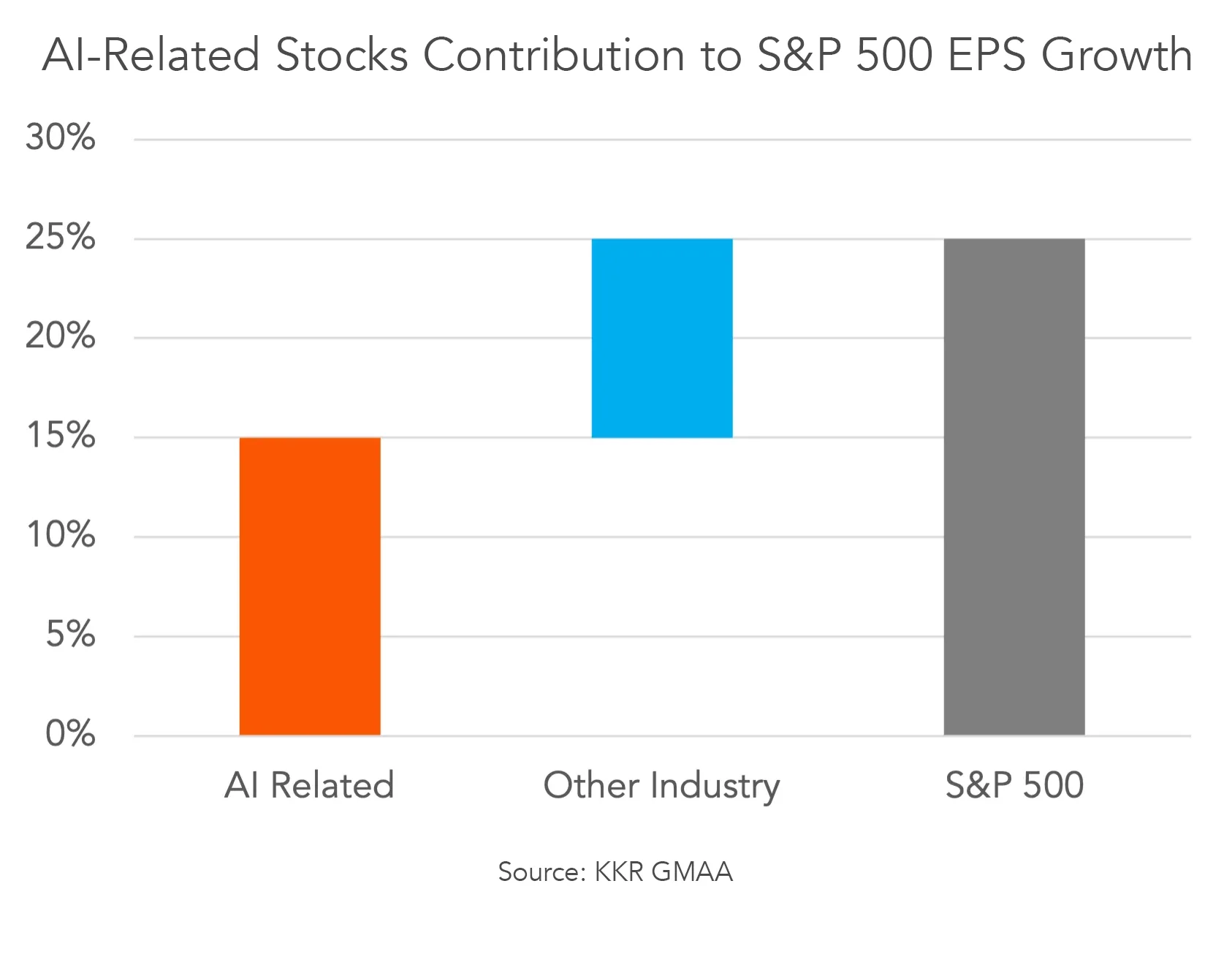
That shift is now showing directly in earnings, as AI-related companies contributed 15 percentage points of the S&P 500’s 25% EPS growth in 1Q2026, or about 60% of the total. Semiconductors and equipment remain the largest direct contributors. Still, the breadth of the contribution across hyperscalers, tech hardware, power, and data-center-related industries underscores that the AI trade has evolved from a narrow narrative into a broader earnings engine for the index.
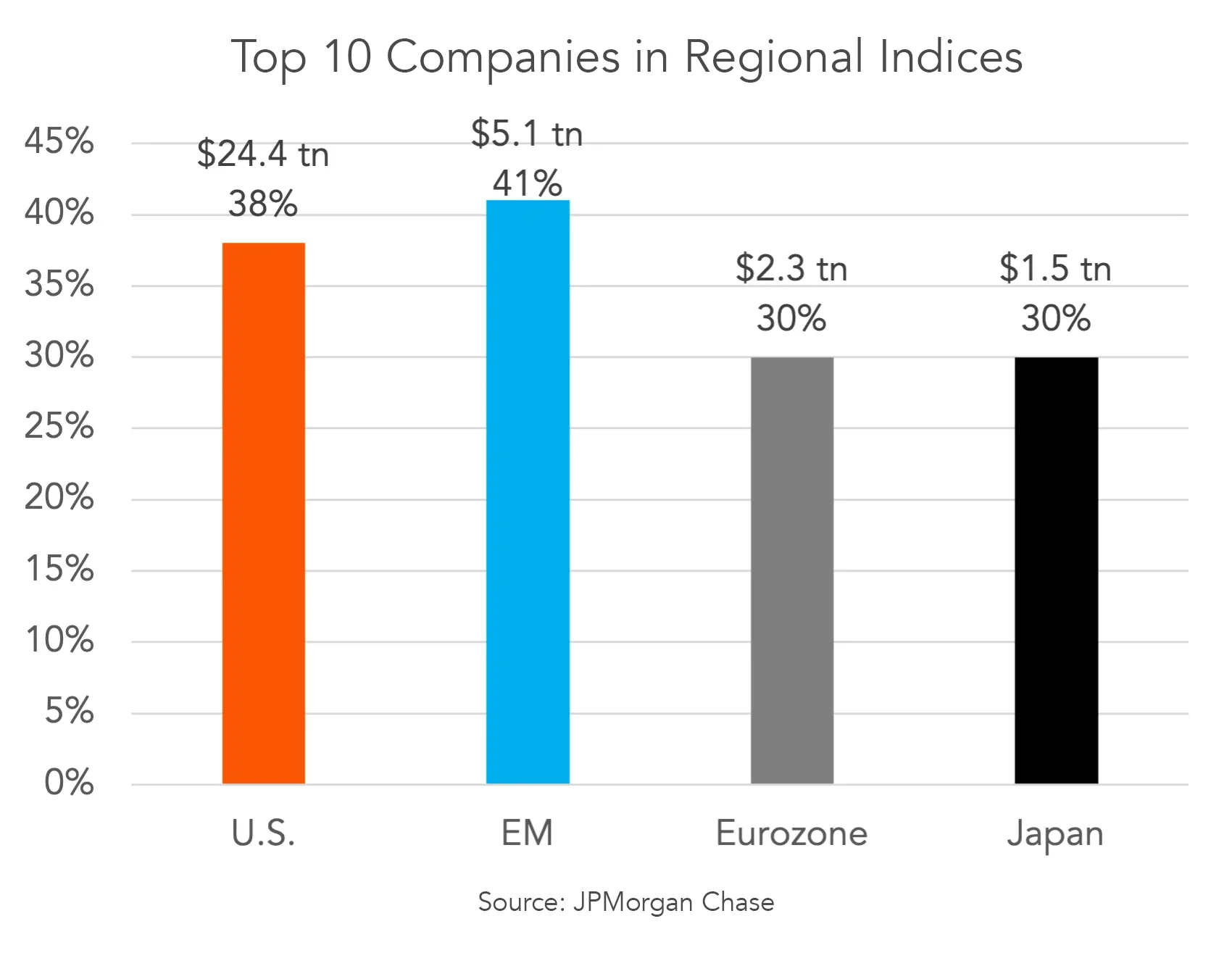
This leadership has also become less U.S.-centric. Emerging markets have benefited significantly from their exposure to the global semiconductor supply chain, particularly in Taiwan and South Korea. The MSCI Emerging Markets Index is up 21% year to date; nearly 70% of that return has been driven by just three semiconductor companies: Taiwan Semiconductor Manufacturing, Samsung Electronics, and SK Hynix. As a result, the U.S. is now sharing the AI stage with key foreign suppliers. However, that does not necessarily mean leadership has become more diversified. In fact, concentration within emerging markets now looks eerily similar to the concentration investors have wrestled with in the S&P 500 over the last several years.
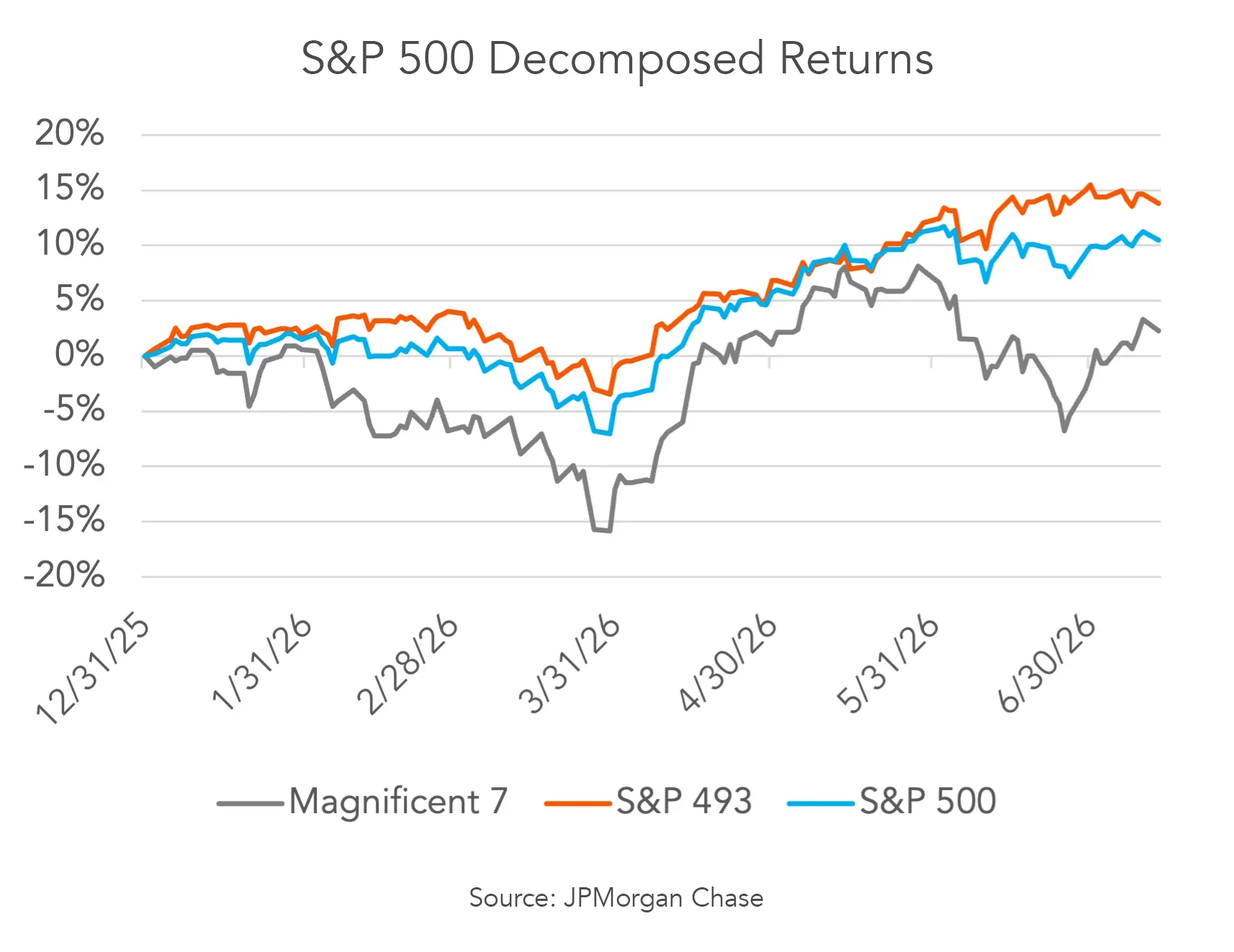
Within the U.S. market, the leadership profile has also changed. The Magnificent Seven, which dominated the early and mid-2020s, have been essentially flat year to date. Meanwhile, the S&P 493 has outpaced the headline S&P 500, and small caps have nearly doubled the S&P 500’s return. This is a meaningful shift. The downstream effects of the AI buildout are beginning to permeate through the broader market, benefiting memory providers, equipment manufacturers, networking companies, data-center infrastructure firms, utilities, industrials, and other companies tied to the physical expansion of AI capacity.
BALANCING OPPORTUNITY AND RISK
Other macro tailwinds are supporting the broadening. Expectations for eventual rate cuts, fiscal and tax policy support, improving earnings growth, and renewed capital markets activity have helped lift sentiment beyond the largest technology names. But the core driver remains the same theme we have discussed over the last several quarters: AI is broadening from a narrow mega-cap growth story into a wider infrastructure and capital-spending cycle.
The reopening of the IPO market reinforces that point. After several years in which many high-growth companies were forced behind the private-market curtain, public market demand has returned for businesses tied to AI, compute, and innovation. Cerebras gave the public a direct way to access AI chip architecture, while SpaceX’s public debut reflected a broader appetite for large, capital-intensive innovation platforms. These IPOs are not the primary driver of index performance, but they are important signals. Strong demand for these offerings suggests that investors are once again willing to fund long-duration growth stories, particularly those tied to AI infrastructure, compute scarcity, or next-generation technology platforms.
Still, the AI narrative is not without risk. As highlighted in our opening commentary, global economic segregation and increasing consolidation among leading companies in the AI ecosystem have significantly narrowed equity risk premia worldwide. The semiconductor rally has, of late, shown some signs of fatigue. Chip stocks sold off sharply in early July as investors questioned whether valuations had run too far ahead of fundamentals. Momentum strategies also experienced a meaningful reversal, a reminder that crowded trades can unwind quickly even when the underlying theme remains intact.
The next phase of the AI cycle will likely be more selective. Companies will need to prove that today’s capital spending can translate into durable revenue growth, attractive margins, and real returns on invested capital.
The key risks are clear: elevated valuations, power constraints, data-center capacity limitations, supply chain bottlenecks, export controls, customer concentration, and uncertainty around the ultimate monetization of AI. The buildout is real, but not every company tied to the theme will be a long-term winner.
The bottom line is that AI infrastructure has delivered earnings and revenue surprises large enough to overwhelm macro and geopolitical noise. The question now is whether that fundamental support can sustain valuations after a historic run. We remain constructive on the long-term AI opportunity, but the market is moving from pricing in promise to pricing in execution. That argues for staying invested, but with greater selectivity, discipline, and attention to concentration risk.
AI continues to reshape the investment landscape, but successful investing requires balancing opportunity with discipline. Interested in learning more? Connect with a Midland Wealth Advisor.


