



Summary:
Higher long-term yields and hyperscalers' bond issuance are reshaping fixed income, creating volatility and opportunity. Active management is critical in balancing duration, credit selectivity, and diversification.
Want a broader view of this quarter's trends? Download the full market outlook for insights across the economy, fixed income, and private markets.
Our Perspective:
The world is moving from frictionless integration toward selective interdependence. Trade remains global, but governments and corporations are increasingly reassessing where critical production occurs, who controls essential inputs, and how much geopolitical risk is embedded in cross-border exposure. For investors, this argues for greater selectivity across regions, countries, sectors, currencies, and asset classes.
REORGANIZATION: A RETHINKING OF GLOBAL SUPPLY CHAINS
Two themes have stood out in fixed income markets over the past quarter. First, long-term Treasury yields moved sharply higher as markets reassessed inflation risk following the energy shock tied to the Iran War and a Federal Reserve that has sounded more hawkish than investors initially expected under Chair Kevin Warsh. Second, the corporate bond market has been absorbing significant new issuance from large technology companies and hyperscalers to fund the buildout of artificial intelligence infrastructure.
These developments fit within the broader framework discussed earlier in this outlook. A more fragmented global economy, less synchronized policy environment, and greater geopolitical uncertainty should result in higher risk premia across markets. For fixed income investors, that means the opportunity set may be improving, but so too is the need to be selective about where to take duration, credit, liquidity, and currency risks.
Together, these themes reinforce why we believe investors should remain active, selective, and nimble.
THE LONG END HAS REPRICED
The most visible sign of recent volatility has been the move in long-term Treasury yields. The 30-year Treasury yield reached 5.18% on May 19, 2026, its highest level since the Global Financial Crisis. Long-duration bonds are more sensitive to changes in interest rates, which can be painful when yields rise, but that same sensitivity can create opportunity when yields appear to have moved too far, too fast.
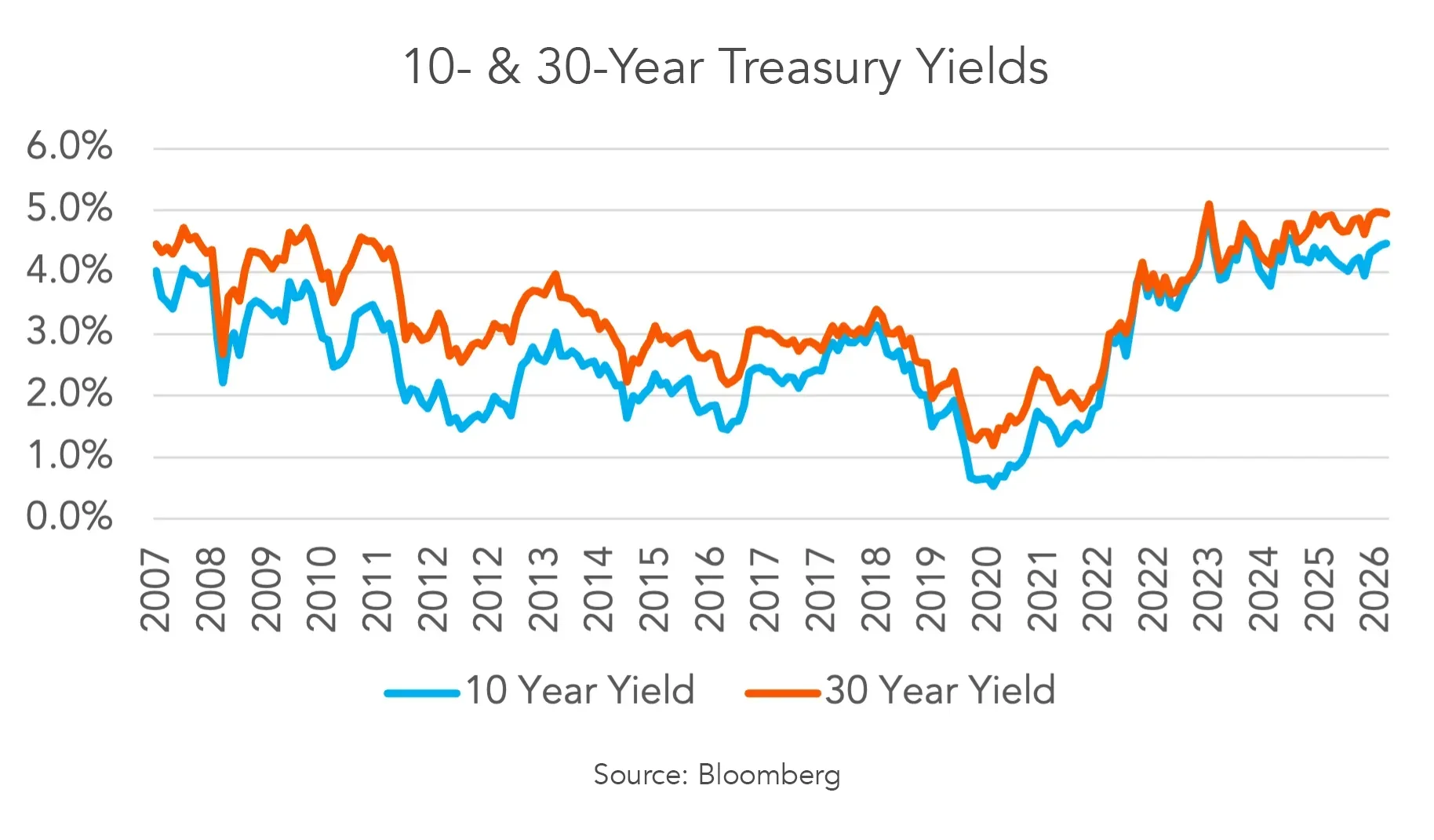
The move toward 5.2% on the 30-year Treasury reflected several concerns. Markets were pricing the possibility that inflation may prove more persistent if the Iran War remains unresolved, that fiscal deficits may keep Treasury supply elevated, and that investors may demand a higher term premium—the extra compensation investors require to hold longer-duration Treasuries. The CBO projects a federal deficit of $1.9 trillion in fiscal 2026 and federal debt rising to 120% of GDP by 2036, which helps explain why markets remain focused on long-term Treasury supply and fiscal sustainability.
Federal Reserve communication has also mattered. At the June FOMC meeting, the Committee kept the target range for the federal funds rate at 3.50% to 3.75%. It noted that inflation remained elevated relative to its 2% objective, partly due to supply shocks including energy. The statement also emphasized that the Committee “will deliver price stability,” language that contributed to the perception that Warsh may be more hawkish than some investors initially expected. The June projections also showed the median 2026 federal funds rate rising to 3.8%, up from 3.4% in the March projection, suggesting the possibility of a higher policy-rate path than markets previously anticipated.
This is where active fixed income management matters. We viewed the move in the 30-year Treasury yield toward 5.2% as a tactical opportunity to add long-duration Treasury exposure within portfolio strategies. If yields mean-revert lower, long-duration Treasury exposure should benefit. That said, risk must be controlled through position sizing, as long-duration Treasuries can remain volatile and depreciate meaningfully if yields continue to rise. Still, today’s higher long-term yields create a more attractive total return setup than existed when yields were much lower. Investors are being paid more in income while also gaining potential price appreciation if yields decline.
HYPERSCALER BOND ISSUANCE IS CHANGING CORPORATE BOND MARKETS
The second major development has been the surge in debt issuance from technology companies and hyperscalers to fund AI-related capital investment. The AI buildout is capital-intensive. Data centers, chips, servers, networking equipment, and energy infrastructure require enormous investment.
Global equity indices have become increasingly concentrated in a relatively small group of firms that are leading the AI infrastructure buildout. What is now becoming clearer is that this concentration is no longer confined to equity markets.
Many hyperscalers, including Alphabet, Amazon, Meta, Nvidia, Oracle, and SpaceX, initially funded this buildout using existing cash flow. Increasingly, however, that investment is being financed through the bond market. As these companies increasingly fund capital expenditures through debt issuance, AI exposure is becoming more visible inside fixed income benchmarks.
Hyperscalers have issued nearly $270 billion in bonds so far in 2026, already more than double their 2025 gross issuance of just under $110 billion. Much of that issuance has been long-term, which brings more duration sensitivity and potential price volatility. Large issuance can also pressure valuations. When the market has to absorb a significant amount of new supply, issuers may need to offer higher yields or wider spreads to attract buyers. Credit spreads—the additional yield investors receive over Treasuries—have widened for hyperscalers as markets digest the supply and weigh uncertainty around project payoffs.
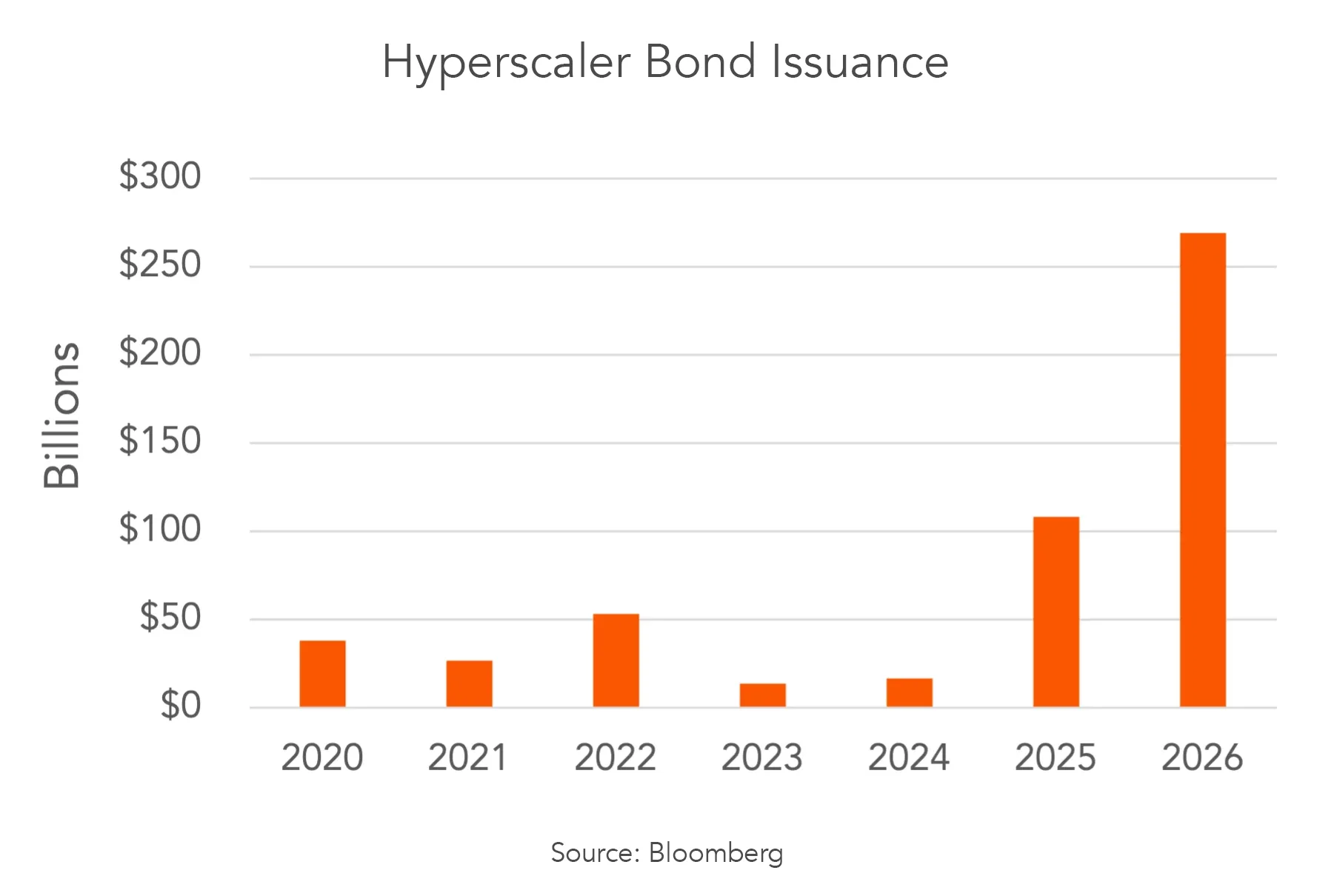
This matters because the more debt an issuer has outstanding, the larger its presence can become in bond indexes. As large technology companies and hyperscalers borrow more, the composition of investment-grade benchmarks may gradually change. Investors may find themselves exposed to AI not only through their equity portfolios but also through their fixed income allocations.
That can create price pressure for existing bonds, but it can also create opportunity. If high-quality companies with strong balance sheets come to market at more attractive spread levels, investors may be better compensated for taking credit risk.
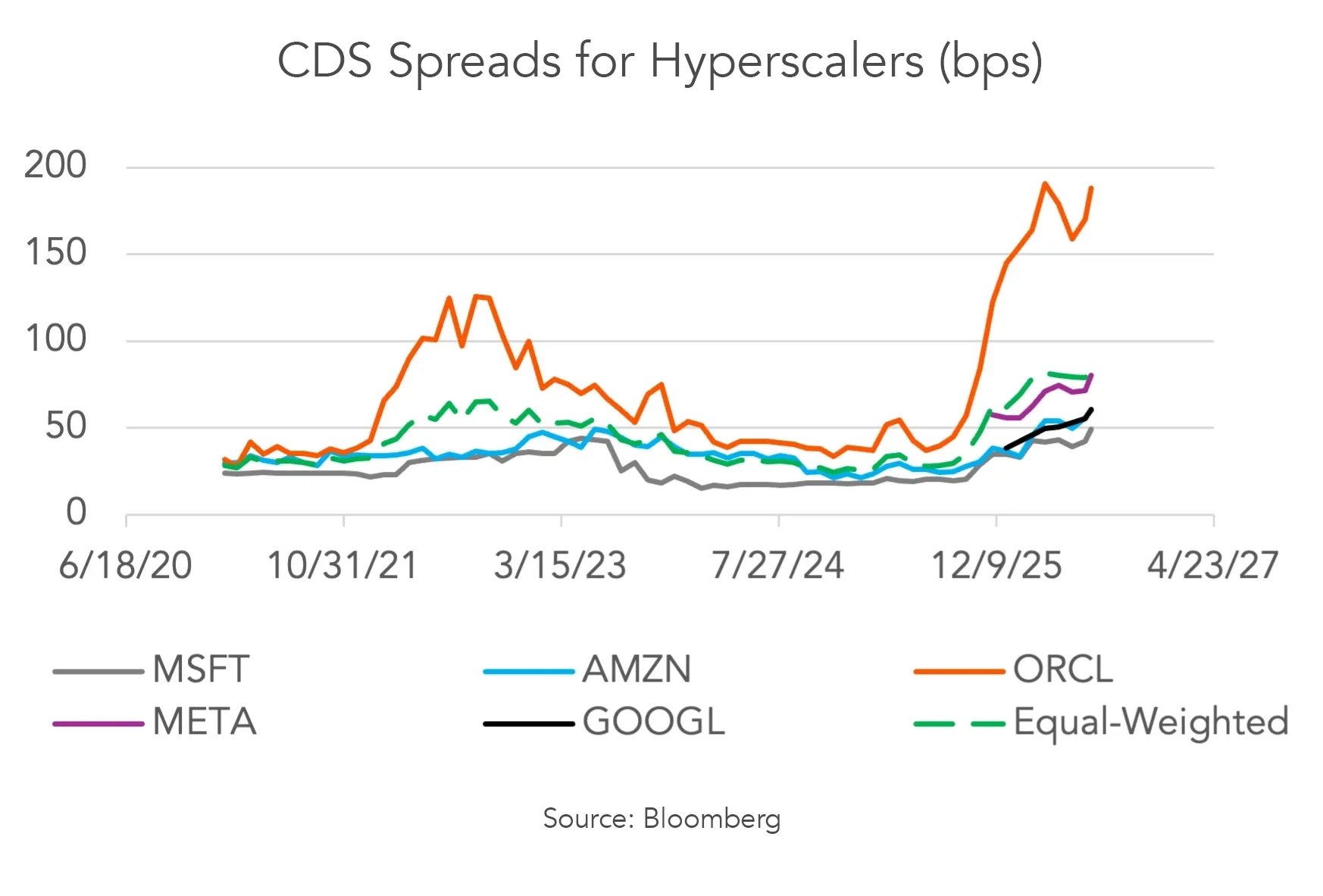
The key is selectivity. Large issuance and uncertainty around AI monetization can pressure hyperscaler bonds and fixed income indexes, but dislocation can also create opportunities. In our view, the goal is not simply to own the benchmark exposure as it changes, but to evaluate where investors are being appropriately compensated for the risks being taken.
WHY ACTIVE MANAGEMENT MATTERS
This environment favors a more active approach to fixed income. The opportunity set is shifting across duration, credit quality, sectors, and maturity ranges. Short-term rates still provide income, while long-duration bonds may offer appreciation potential if yields decline. Corporate credit may also become more attractive on a relative basis if heightened issuance creates better valuations. Each opportunity carries a different risk profile, which makes discipline and flexibility important.
For accounts invested in our strategies, nimbleness remains central to how we manage fixed income. Strategies can adjust as conditions change, whether that means emphasizing short duration, adding long duration when yields move too far, or selectively adding corporate credit when valuations become more attractive, or looking beyond traditional markets to alternative assets like infrastructure and insurance-linked notes. This dynamic approach is difficult to replicate with a static portfolio or individual bonds.
We continue to evaluate the fixed income market through the same disciplined lens we have always used. As a team, we are focused on where investors are being paid appropriately, where risks are attractive, and where we can improve portfolio outcomes. In a more fragmented world, that means being willing to invest beyond traditional markets, particularly where correlations between asset classes and regions remain lower, and diversification can still provide meaningful portfolio benefits. It also means remaining prepared to become more defensive if risk premia fail to compensate investors for the uncertainty ahead adequately. In today’s fixed income market, being dynamic is not merely useful; it is necessary.
In today's fixed income market, active management, discipline, and flexibility matter more than ever. Connect with a Midland Wealth Advisor.


